
If you run a business in India – a factory in Pune, an IT company in Bengaluru, or a chain of retail outlets across five states – you already know that compliance is not a once-a-year formality. It is a moving target. Between the four new Labour Codes, state-specific Shops & Establishments rules, PF and ESI deadlines, POSH requirements, GST filings, and MCA/ROC obligations, most HR and compliance teams are tracking hundreds – sometimes thousands – of obligations across multiple locations and departments.
In this guide, we break down what compliance management software actually does, why it matters more than ever for Indian businesses in 2026, the features worth paying for, and a detailed, unbiased look at the top 10 compliance management software options available in India today – from enterprise-grade GRC platforms to lightweight tools built for small businesses.
Quick Answer: The best compliance management software in India depends on your business size and need. For large enterprises and multi-state employers, TeamLease RegTech, Simpliance, and Komrisk lead the market with deep statutory databases and audit-ready workflows. For BFSI and regulated financial institutions, Komply360 and MetricStream are purpose-built. For small businesses and startups that mainly need HR/payroll statutory compliance (PF, ESI, PT, TDS), greytHR, factoHR, and Zoho Payroll offer affordable, fast-to-implement solutions.
What Is Compliance Management Software?
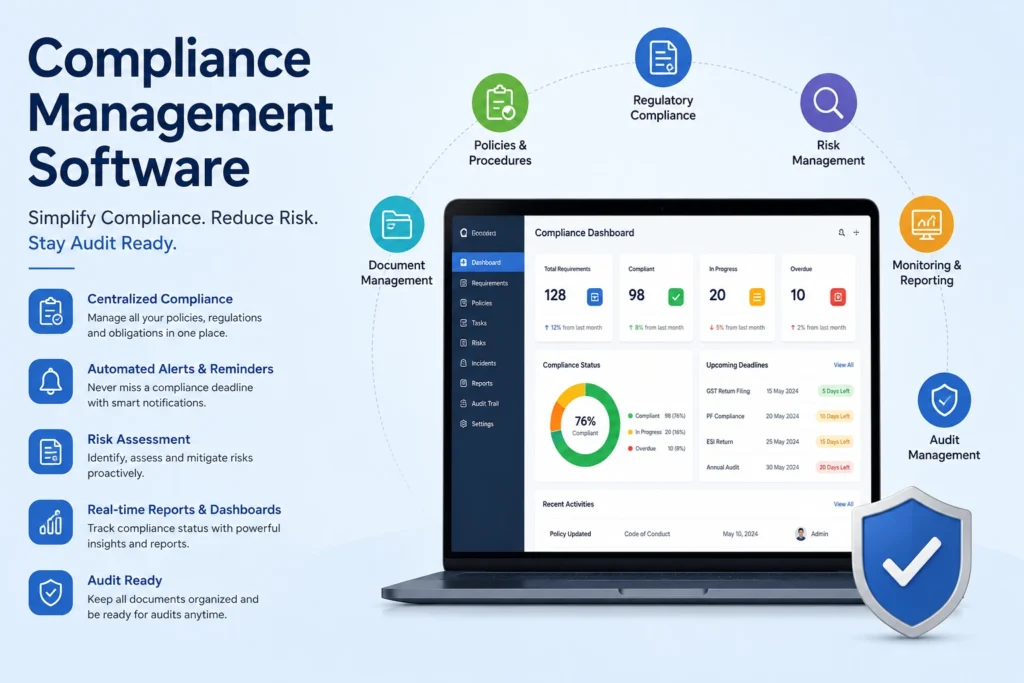
Compliance management software (also called a compliance management system or compliance management solution) is a digital platform that helps organisations identify, track, execute, and prove adherence to the laws, regulations, and internal policies that apply to them. Instead of relying on manual trackers, the software automatically maps which statutory obligations apply to your business – based on your industry, headcount, state, and entity structure – and then converts them into a running calendar of tasks with owners, due dates, reminders, and documentary evidence.
At its core, good compliance management software in India typically covers:
- Statutory compliance tracking — labour laws, PF, ESI, professional tax, factories act, shops & establishments act, and the new Labour Codes.
- Corporate/secretarial compliance — ROC filings, board meeting compliance, and Companies Act obligations.
- Internal policy compliance — POSH, code of conduct, data privacy, and SOP adherence.
- Licence and registration management — tracking renewal dates for trade licences, factory licences, and industry-specific permits.
- Risk, audit, and reporting — dashboards that show compliance health, overdue items, and audit trails for regulators or investors.
Some platforms are horizontal (covering statutory, legal, and internal compliance broadly), while others are vertical – built specifically for labour law, payroll Management, information security (ISO/SOC 2), or environmental compliance. Choosing the right one starts with understanding which category your business actually needs.
Why Indian Businesses Need Compliance Management Software in 2026
India’s regulatory environment is unusually complex compared to most markets, and it is changing quickly. Here’s why compliance software has moved from “nice to have” to business-critical for Indian companies:
1. The New Labour Codes Have Changed the Rules
The four consolidated Labour Codes reshaped decades-old rules around wages, social security, industrial relations, and occupational safety. For HR teams, this means updated wage definitions, revised PF/gratuity calculations, and new compliance obligations that spreadsheets simply cannot keep pace with. Software that auto-updates as regulations change removes the burden of tracking every notification manually.
2. Multi-State Operations Multiply Complexity
A company operating in five states doesn’t just have one set of labour laws to follow – it has five sets of state-specific rules layered on top of central legislation, each with its own minimum wages, professional tax slabs, and Shops & Establishments requirements. Compliance software centralises this so HR and compliance heads get one dashboard instead of five separate trackers.
3. Regulators Are Going Digital — and So Are Penalties
Bodies like EPFO, ESIC, and the Income Tax Department increasingly rely on system-based cross-checks between filed returns and best payroll software data. A mismatch that used to go unnoticed for months can now trigger an automated notice within days. Manual, disconnected processes are far more likely to produce the small errors that these systems flag.
4. Investor and Audit Due Diligence Has Gotten Stricter
Whether you’re raising a funding round, going through statutory audit, or onboarding an enterprise client who insists on vendor compliance checks, having a clean, documented compliance trail is no longer optional. Compliance management software gives you audit-ready records instead of a scramble through email threads and physical files.
5. The Cost of Non-Compliance Is Rising
Penalties for statutory lapses – from PF and ESI delays to POSH non-adherence – carry real financial and reputational cost, and in some cases, personal liability for directors and compliance officers. Automated alerts and escalation workflows dramatically reduce the chance of a deadline slipping through unnoticed.
Key Features to Look for in Compliance Management Software
Not all compliance management systems are built the same way. Before you shortlist vendors, evaluate them against these criteria:
- Comprehensive statutory database: Look for platforms that track compliances across central, state, and municipal levels, and update this database as laws change – ideally with a dedicated legal research team behind it.
- Auto-configuration by profile: The system should automatically identify which compliances apply to you based on industry, state, headcount, and entity type, rather than requiring you to configure everything manually.
- Multi-entity and multi-location support: Essential if you operate across branches, factories, or group companies – you need entity-level and consolidated views.
- Automated alerts and escalation: Reminders should go to the task owner first, then escalate to management automatically if a deadline is missed.
- Evidence and document management: The ability to attach proof of filing (challans, returns, certificates) directly against each compliance item, for audit readiness.
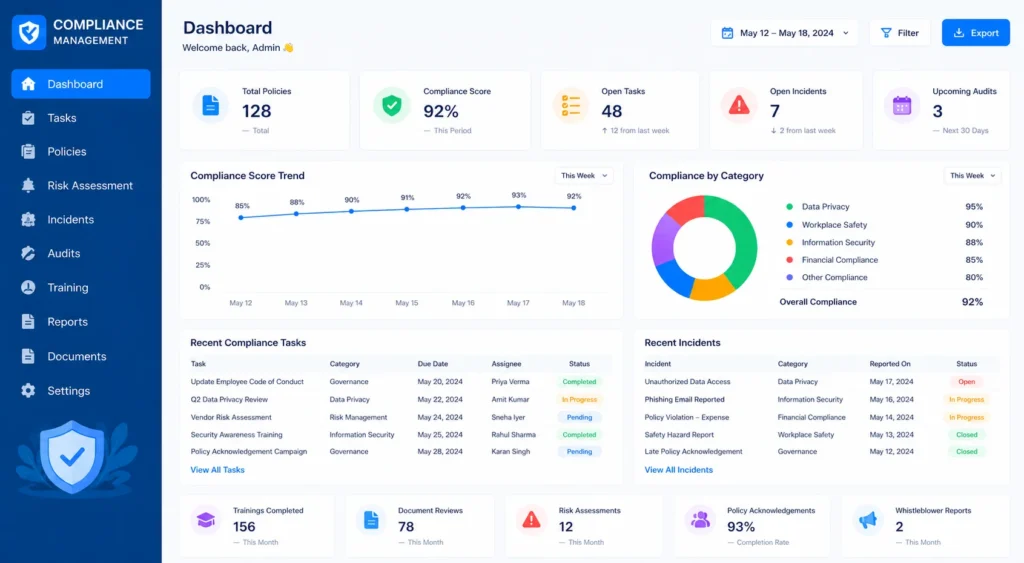
- Dashboards and reporting: Real-time, role-based views – leadership needs a risk summary; compliance owners need a task list.
- Integration capability: API or native integration with payroll software, HRMS, or ERP systems saves significant manual data entry.
- Mobile access: Field-level teams and plant managers often need to update compliance status on the go.
- Data security certifications: Look for ISO 27001, SOC 2, or equivalent certifications, especially if the platform will store sensitive employee or financial data.
- Scalability and support: The platform should grow with you – from a single office to a pan-India, multi-entity operation – backed by responsive customer support and an in-house legal/compliance team.
Top 10 Compliance Management Software in India — Quick Comparison
| Software | Best For | Key Strength | Deployment | Pricing Model |
| compliance management (Trilliant Software) | Large enterprises, multi-state operations | 1,500+ Acts & 69,000+ compliances tracked in near real time | Cloud (SaaS) | Custom quote |
| Simpliance (Simpliance Classic) | Manufacturing & multi-location employers | AI-powered SEAL audit engine for PF/ESI/wage risk | Cloud (SaaS) | Custom quote |
| Komrisk (Lexplosion Solutions) | Enterprises needing an all-in-one GRC hub | Statutory + internal + litigation + contract modules in one platform | Cloud (SaaS) | Custom quote |
| Legasis (Legatrix) | Mid-size companies wanting a guided approach | Legal-expert-backed compliance tracking | Cloud (SaaS) | Custom quote |
| ComplyKaro | Mid-size companies wanting a guided approach | Legal-expert-backed compliance tracking | Cloud (SaaS) | Custom quote |
| Komply360 | Banks, NBFCs & financial institutions | AI assistance with branch-level compliance visibility | Cloud (SaaS) | Custom quote |
| MetricStream | Large / global enterprises, BFSI, healthcare | Integrated global GRC suite with audit & risk modules | Cloud / On-prem | Enterprise quote |
| greytHR | Small & mid-size businesses (HR + payroll) | Affordable all-in-one HRMS with built-in statutory compliance | Cloud (SaaS) | From ~₹2,495/month |
| factoHR | SMEs wanting fast payroll compliance rollout | Multi-state PT/LWF automation, 2–5 day implementation | Cloud (SaaS) | Per-employee, custom |
| Zoho Payroll / Zoho People | Startups & very small teams | Low entry cost with native statutory filing support | Cloud (SaaS) | Free up to 10 employees, then per-employee |
Top 10 Compliance Management Software in India (2026)
Below is a detailed, feature-by-feature look at the leading compliance management software options for Indian businesses, ranked with a mix of enterprise-grade and SME-friendly platforms so you can find the right fit regardless of company size.
1. compliance management (Trilliant Software) — Best Overall for Large & Multi-State Enterprises
Formerly known as Avantis RegTech, Trilliant Software is one of India’s most established compliance management platforms, built by TeamLease, one of the country’s largest staffing and HR services companies. Its flagship product, Trilliant Software (previously Avacom), gives businesses a real-time compliance dashboard backed by a legal and compliance database covering more than 1,500 Acts and 69,000 compliances, updated regularly as central and state regulations change.
Key strengths:
- Extensive, near real-time updated statutory database covering central, state, and local regulations
- Strong track record with large, multi-location enterprises across India
- Labour compliance automation for returns, registers, and challans, with payroll system integration
- Backed by an in-house team of legal and compliance professionals
Best for: Large enterprises and organisations with operations across multiple states that need a single, authoritative compliance system of record.
2. Simpliance (Simpliance Classic) — Best for Labour Law & Wage Compliance
Simpliance, operated by Aparajitha, is a widely used labour law compliance platform designed to auto-configure applicable compliances based on your state, headcount, and industry. Its standout feature is the SEAL (Simpliance Enabled Audit Logic) engine, which uses AI and machine learning to run automated audits on high-risk areas such as minimum wages, PF and ESI contributions, national/festival holidays, leave encashment, and bonus calculations — catching payroll compliance risks before payday rather than after.
Key strengths:
- Auto-configuration of compliances by state, headcount, and industry
- AI-driven SEAL audit engine for proactive wage and statutory risk checks
- Real-time monitoring, risk scoring, and email alerts in a single cloud platform
- Evidence management for audit readiness
Best for: Manufacturing companies, staffing firms, and multi-location employers where wage and labour law accuracy is business-critical.
3. Komrisk (Lexplosion Solutions) — Best All-in-One GRC Platform
Komrisk, built by Lexplosion Solutions, is a SaaS-based regulatory compliance management system used by 600-plus companies across India and globally. It stands out for bundling statutory compliance with internal compliance, litigation management, contract management, and licence management in a single platform, giving legal and compliance heads a genuinely unified view instead of juggling separate tools.
Key strengths:
- Combines statutory, internal, litigation, contract, and licence management modules
- Configurable workflows and escalation mechanisms tailored to your organisation
- Dashboards built for leadership-level visibility into compliance status and risk exposure
- Built to recognised security standards, including ISO 27001 and regular penetration testing
Best for: Enterprises that want to consolidate statutory compliance, legal risk, contracts, and litigation tracking into one system rather than running multiple point solutions.
4. Legasis (Legatrix) — Best for Legal-Led Compliance Management
Legasis Services combines its Legatrix compliance software with legal advisory services, positioning itself as a one-stop solution for enterprise-wide legal and regulatory obligations. This hybrid model — software plus legal expertise — is particularly useful for companies that want more than just a tracking tool and prefer a compliance partner who can also interpret regulatory changes for them.
Key strengths:
- Legatrix platform designed for enterprise-wide legal compliance tracking
- Backed by legal advisory expertise, not just software support
- Suited for businesses of varying sizes, from mid-market to large enterprise
Best for: Companies that want their compliance software vendor to also double as a legal compliance advisor.
5. ComplyKaro — Best for Guided, Expert-Backed Compliance
ComplyKaro takes a similar hybrid approach, pairing legal expertise with technology to manage statutory obligations for Indian businesses. It’s a good fit for mid-size companies that don’t yet have a large in-house compliance team and want a vendor that can guide them through what applies to their business, not just list it.
Key strengths:
- Legal-expert-backed approach to compliance identification and tracking
- Positioned for businesses that need guidance alongside software
- Structured onboarding to map applicable compliances to your business profile
Best for: Mid-size companies without a large in-house legal/compliance function.
6. Komply360 — Best for BFSI & NBFCs
Komply360 is purpose-built for the complex oversight needs of banks, NBFCs, and financial institutions operating in India’s tightly regulated financial sector. It centralises obligations, automates workflows, and delivers real-time tracking across jurisdictions, with built-in AI assistance and branch-level visibility designed for the scale of modern financial enterprises.
Key strengths:
- Purpose-built for BFSI and NBFC regulatory environments
- Branch-level visibility for institutions with wide geographic footprints
- AI assistance for obligation tracking and workflow automation
Best for: Banks, NBFCs, and financial institutions that need jurisdiction-aware, branch-level compliance tracking.
7. MetricStream — Best Global-Grade GRC Suite
MetricStream is a global leader in Governance, Risk, and Compliance (GRC) software, with integrated modules for compliance, audit, and risk management. It’s widely adopted across high-compliance sectors including BFSI, healthcare, manufacturing, and government, and is a natural fit for large Indian enterprises with global operations or investors who expect an internationally recognised GRC framework.
Key strengths:
- Comprehensive, integrated GRC suite spanning compliance, audit, and risk
- Proven adoption across BFSI, healthcare, manufacturing, and government sectors globally
- Enterprise-scale configurability for complex organisational structures
Best for: Large enterprises and multinationals that need a globally recognised GRC platform, not just an India-specific compliance tracker.
8. greytHR — Best for Small & Mid-Size Businesses (HR + Payroll Compliance)
greytHR is one of India’s most popular cloud-based HRMS and payroll platforms, and its built-in statutory compliance module makes it a genuinely strong choice for small and mid-size businesses that need PF, ESI, professional tax, and TDS compliance handled alongside payroll – without buying a separate, heavyweight compliance system. The software auto-computes deductions across all 28 states, generates statutory reports like Form 24Q with a single click, and updates automatically whenever a central act changes.
Key strengths:
- Affordable, accessible pricing – plans start from roughly ₹2,495/month for up to 50 employees, covering payroll, compliance, leave, and attendance together
- Auto-computed PF, ESI, PT, LWF, and TDS across all Indian states
- Single-click generation of statutory reports and forms
- Easy to implement without a dedicated compliance team
Best for: Small businesses and SMEs that primarily need HR/payroll statutory compliance handled reliably and affordably.
9. factoHR — Best for Fast-Growing SMEs Needing Multi-State Payroll Compliance
factoHR focuses heavily on Indian payroll depth – multi-state professional tax and labour welfare fund deductions, PF, ESI, TDS, Form 16, and Form 24Q outputs — with a faster implementation timeline (often 2 to 5 days) compared to larger enterprise platforms. It’s built for growing SMEs that need statutory compliance handled correctly from day one without a long, drawn-out rollout.
Key strengths:
- Deep multi-state statutory compliance handling (PT, LWF, PF, ESI, TDS)
- Fast implementation and migration support from platforms like greytHR, Zoho, or Keka
- Transparent, per-employee pricing
- Direct bank API integration for payroll disbursement alongside compliance tracking
Best for: Fast-growing SMEs that want statutory payroll compliance handled quickly, without a long implementation cycle.
10. Zoho Payroll / Zoho People — Best Low-Cost Entry Point for Startups
Zoho Payroll, part of the broader Zoho ecosystem, is a practical starting point for very small teams and startups that need basic statutory compliance (PF, ESI, PT, TDS) handled correctly without investing in a dedicated compliance platform. It’s free for up to 10 employees and scales on a per-employee basis as the team grows, making it one of the most accessible entry points on this list.
Key strengths:
- Very low entry cost – free for up to 10 employees
- Native statutory filing support integrated with payroll
- Easy integration with other Zoho apps if you’re already in that ecosystem
- Simple enough to self-manage without a dedicated compliance hire
Best for: Startups and very small businesses that need basic statutory compliance without enterprise-level complexity or cost.
What to Ask Before You Sign: Vendor Evaluation Checklist
Most compliance software demos look impressive – clean dashboards, colourful charts, confident sales pitches. The real differentiators show up in the details. Before committing, ask every shortlisted vendor these questions:
- How often is your statutory database updated, and how? Ask whether updates are driven by an in-house legal research team or a smaller external panel – this affects how quickly Labour Code and state-level changes reach your account.
- What happens when a compliance deadline is missed? Understand the escalation logic: does it just email the task owner, or does it automatically notify management after a set number of days?
- Can the system handle our specific entity structure? If you have multiple group companies, factories, or branch offices, confirm the platform supports both entity-level and consolidated reporting – not just a single-location view.
- What does onboarding actually involve? Ask for a realistic implementation timeline, not a marketing number. Find out whether your team will need to manually configure applicable laws or whether auto-configuration genuinely works out of the box.
- How is pricing structured as we grow? Understand whether pricing is per-employee, per-entity, per-module, or a flat enterprise licence – and get clarity on renewal terms before signing.
- What security certifications does the platform hold? For any system storing employee, payroll, or financial compliance data, ISO 27001 or SOC 2 certification (or equivalent) should be a baseline requirement, not a nice-to-have.
- Can we see a reference customer in our industry? A manufacturing company and an IT company have very different compliance profiles – ask for a reference or case study from a business similar to yours.
How Much Does Compliance Management Software Cost in India?
Pricing varies significantly based on company size, number of entities, and the depth of statutory coverage you need:
- Small business / SME payroll-integrated compliance: Entry-level plans typically start in the range of a few thousand rupees per month for smaller teams (for example, plans starting around ₹2,495/month for up to 50 employees), or free/low-cost tiers for very small teams, scaling on a per-employee basis as headcount grows.
- Mid-size dedicated compliance platforms: Most vendors in this category price on a custom quote basis, factoring in number of locations, entities, and the compliance modules you need (statutory only vs. statutory + internal + litigation).
- Enterprise GRC platforms: Large-scale, multi-module GRC suites are typically priced through custom enterprise contracts based on user count, modules, and integration requirements.
Because pricing is rarely published for enterprise and mid-market platforms, the most reliable way to get an accurate number is to request a demo and a tailored quote based on your entity structure, headcount, and locations.
Frequently Asked Questions
What is the best compliance management software in India?
There isn’t a single “best” platform for every business – the right choice depends on your size and industry. Trilliant Software, Simpliance, and Komrisk are strong choices for large, multi-state enterprises; Komply360 and MetricStream suit BFSI and regulated sectors; and greytHR, factoHR, or Zoho Payroll work well for small businesses that need payroll-integrated statutory compliance.
What is the difference between compliance management software and a compliance management system?
In practice, the terms are used interchangeably in India. “Compliance management software” typically refers to the tool itself, while “compliance management system” (CMS) can refer more broadly to the combination of software, processes, and people your organisation uses to manage regulatory obligations.
Can small businesses afford compliance management software?
Yes. Several platforms – including Zoho Payroll (free for up to 10 employees) and greytHR (plans starting from a few thousand rupees per month) – are specifically priced for small teams, making dedicated compliance tracking accessible even without a large budget.
Does compliance management software cover the new Labour Codes?
Reputable Indian compliance platforms update their statutory databases as regulations change, including changes introduced by the consolidated Labour Codes. When evaluating vendors, specifically ask how frequently their compliance database is updated and whether Labour Code changes have already been reflected in the platform.
Is compliance management software only for HR compliance?
No. While labour law and payroll compliance (PF, ESI, PT, TDS) are common starting points, comprehensive platforms also cover corporate/secretarial compliance, licence and registration renewals, POSH and internal policy compliance, contract and litigation tracking, and — for regulated sectors — information security and financial compliance.
How long does it take to implement compliance management software?
This varies by platform and company complexity. SME-focused platforms like factoHR advertise implementation in as little as 2 to 5 days, while enterprise-grade, multi-entity rollouts with custom workflows can take several weeks to configure properly.
Should IT companies use different compliance software than manufacturing companies?
Often, yes — at least in emphasis. Manufacturing companies typically need stronger coverage of Factories Act, contractor labour (CLRA), and state-specific industrial compliance, which platforms like Simpliance handle well. IT companies tend to prioritise Shops & Establishments compliance, POSH, and information security certifications, where a broader GRC platform or a dedicated InfoSec compliance tool may be more relevant.